Practical Daily Journal Recommendations for Writers Who Actually Write
For as long as I can remember, I have kept a journal. Not the kind you decorate with stickers and leave on a shelf, but the kind that gets shoved into a backpack, splashed with coffee, and written in at odd hours. Over thirty years of this habit, I have tested dozens of notebooks, from cheap spiralbounds to leather-bound investments. The search for the perfect daily companion never really ends, but the good news is that most writers can find something that works without spending a fortune. These daily journal recommendations come from real use, not from catalog descriptions.
What Makes a Journal Work for Daily Use
A daily journal needs to survive being carried around. It needs paper that can handle whatever pen you grab, and it needs to open flat so you can write in it on a train or at a café counter. I have learned that the binding matters as much as the cover. A sewn binding, for example, lets the notebook lie open without you holding it down. That is a small thing until you are balancing a cup of tea and trying to write a sentence before the thought evaporates.
The paper weight and finish also matter more than most beginners realise. If you use fountain pens, you need paper that will not bleed or feather. If you use a ballpoint or a gel pen, you still want something that feels good under your hand. Paper that is too slick can make your handwriting slide into a mess. Paper that is too absorbent slows you down. I have found that 80 to 100 gsm paper is a sweet spot for most writers, though some Japanese papers go thinner and still hold ink beautifully.
When I talk about daily journal recommendations, I mean notebooks that you can buy again and again, not one-off special editions. Consistency matters. You should not have to relearn your notebook every time you start a new volume. A good daily journal becomes an extension of your hand, and that only happens when you stick with the same format long enough to build muscle memory.
Notebooks That Have Earned Their Place
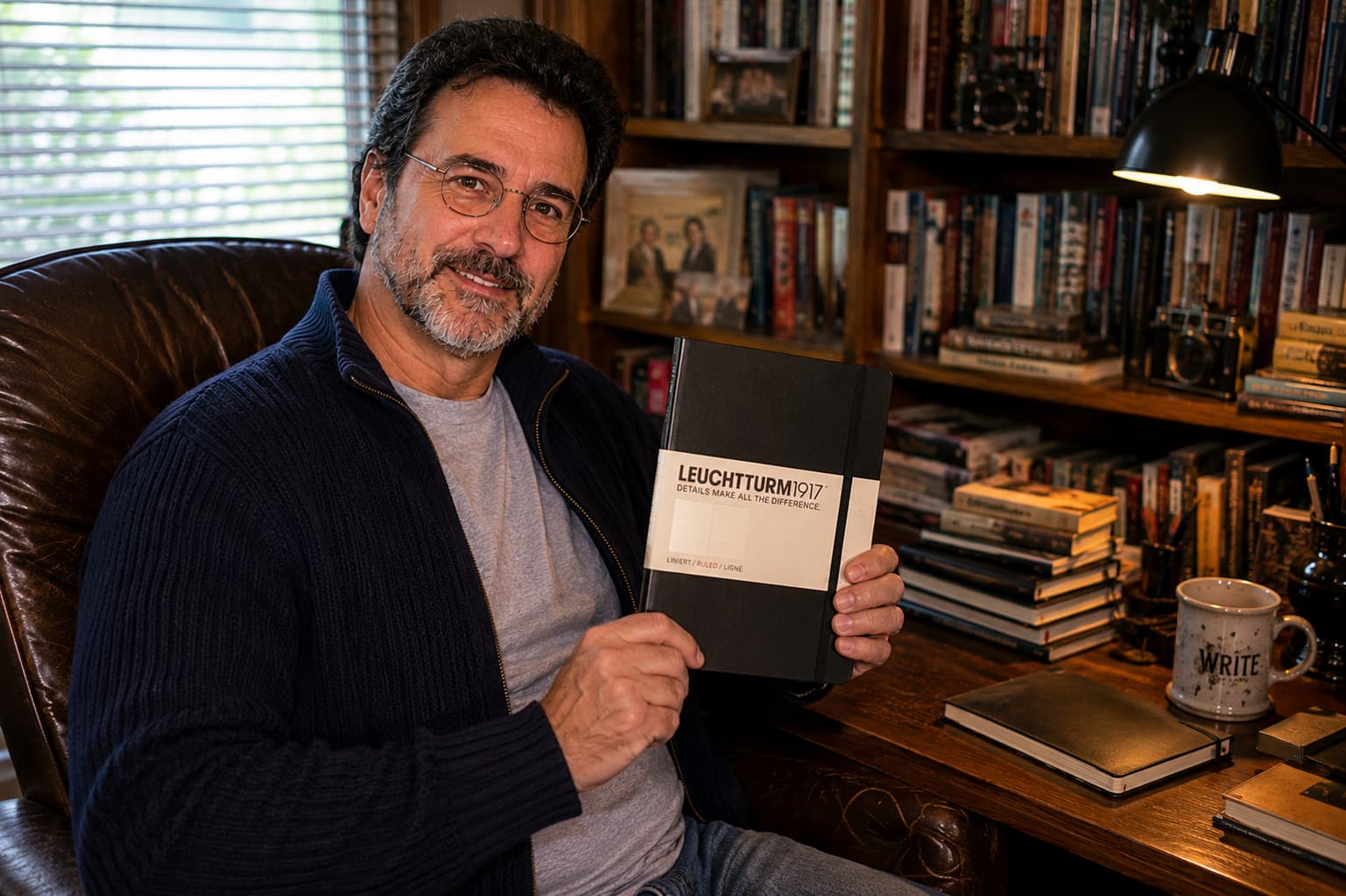
Over the years, several brands have become staples on my desk and in my bag. Leuchtturm1917 is probably the most famous example of a reliable daily notebook. Their 80 gsm paper works well with most fountain pens, and the numbered pages are a blessing if you keep an index. I have filled maybe two dozen of these over the years. The hardcover version stands up to serious abuse, and the softcover fits into a coat pocket without bulging too much.
Moleskine is another name that comes up constantly. I want to be honest here: their paper quality has varied over the years, and some fountain pen users find it too absorbent. But if you use a Pilot G2 or a standard ballpoint, Moleskine notebooks are perfectly fine. The classic black cover and the elastic band closure are iconic for a reason. They are not my first choice for daily writing, but I have used them on trips and found them serviceable.
Rhodia makes a different kind of product. Their pads and notebooks use Clairefontaine paper, which is smooth and fountain-pen friendly. The spiral-bound Rhodiarama notebooks are excellent for daily journal use because the pages tear out cleanly and the cover is sturdy. I keep one on my desk for morning pages. The paper handles wet ink without bleeding, which is more than I can say for many competitors.
Field Notes notebooks are smaller and more portable. They are not designed for lengthy journal entries, but they are perfect for capturing quick thoughts throughout the day. The graph paper option is handy if you sketch or diagram. I have a pack of these in my car for when ideas hit at a stoplight. They are not built for fountain pens, but for ballpoints and pencils they work wonderfully.
Tomoe River Paper deserves its own mention. This is the paper used in the Hobonichi Techo and in Nanami Paper notebooks. It is incredibly thin, almost like tracing paper, but it resists bleeding and feathering better than many thicker papers. The Hobonichi Techo is a daily planner that many writers repurpose as a journal. The paper takes fountain pen ink with a beautiful sheen. If you write with a Lamy Safari or any wet fountain pen, Tomoe River Paper will show you what your ink can really do.
Traveler's Notebook and the Modular Approach
The Traveler's Notebook system from Midori is another favorite among daily writers. It uses a leather cover that holds multiple inserts. You can swap out inserts for different purposes: one for daily journaling, one for notes, one for sketches. The paper is Tomoe River Paper in the official refills, though third-party options exist. I have been using a Traveler's Notebook for about three years now, and I appreciate how easy it is to reconfigure. If I finish a journal insert but still have room in the sketch insert, I just replace the finished one without disturbing the rest.
The modular approach is not for everyone. Some people prefer a single notebook that does everything. But if you like to keep different kinds of writing separate, the Traveler's Notebook system is worth considering. The leather cover ages beautifully, and the whole thing fits in a jacket pocket.
Hardcover vs. Softcover: A Real Trade-off
Hardcover notebooks protect your pages better, but they add weight and bulk. Softcover notebooks are lighter and more flexible, but they can get bent in a bag. I have owned both and switch depending on the season. In winter, when I carry a larger bag, I use a hardcover Leuchtturm1917. In summer, I switch to a softcover or a smaller notebook like a Moleskine cahier.
Baron Fig notebooks offer a good middle ground. Their softcover notebooks have a sturdy cover that resists bending, and the paper is excellent for fountain pens. The dot grid is a nice alternative to lined or blank pages. I have used Baron Fig journals for both daily writing and project notes, and they hold up well.
Paper Quality and Pen Compatibility
If you are serious about fountain pens, you need paper that can handle the ink. Exacompta and Clairefontaine make notebooks with 90 gsm paper that is smooth and well-behaved. Rhodia uses the same paper in many of its products. For daily journaling, I recommend Rhodia's Webnotebook or the Exacompta basic notebooks. They are affordable enough to use every day and good enough to show off your ink shading.
Dingbats notebooks use 100 gsm paper that is thick and creamy. They are vegan-friendly and the paper is fountain pen safe. I have tested a Dingbats notebook for about six months, and the paper handled everything from a wet Lamy Safari to a dry Pilot G2 without any problems. The cover is soft and flexible, and the elastic band closure keeps it shut in a bag. Dingbats is not as well known as Leuchtturm1917 or Moleskine, but it deserves more attention for daily use.
Archer & Olive uses 120 gsm paper that is thick enough for watercolor washes and heavy ink applications. Their notebooks are beautiful and well-made, but the paper weight makes the notebooks bulky. For a daily journal that you carry everywhere, 120 gsm might be too heavy. I use Archer & Olive notebooks for special projects, not for everyday quick entries.
Rocketbook: The Reusable Option
Rocketbook is a different beast. It is a reusable notebook that you write on with a special pen and then wipe clean with a damp cloth. The pages are synthetic and the writing is saved via an app before you erase them. I have been skeptical of this concept for years, but I tried it last year and found it useful for capture journaling. If you write down daily thoughts and then transfer them to a digital system, Rocketbook saves paper and clutter. But if you want a permanent physical archive, it is not the right choice. The tactile experience is not the same as writing on paper, and the pen is required. Still, for someone who wants to reduce waste, it is an option worth knowing about.
Budget-Friendly Choices That Work
You do not need to spend thirty dollars on a notebook to start a daily journal. Muji notebooks are inexpensive and reliable. Their paper is smooth and handles fountain pens reasonably well for the price. I have bought dozens of Muji notebooks over the years, and they have never disappointed me. The A5 size is perfect for daily journaling and fits in most bags.
Paperblanks makes decorative notebooks that are often sold in gift shops. The paper quality is decent, though not as good as Clairefontaine or Tomoe River. If you find one on sale, it can be a fine daily journal. The covers are ornate and might appeal to writers who want their notebook to look special.
Peter Pauper Press produces a line of small, affordable notebooks with good paper. They are not widely available in big box stores, but online retailers carry them. I have used their pocket notebooks for quick notes and found the paper adequate for fountain pens. They are not as famous as Field Notes, but they cost less.
A Practical Routine for Choosing
If you are new to daily journaling, I recommend starting with a single notebook and using it for at least a month before deciding if it works. Switch only if the paper bleeds, the binding breaks, or the size does not fit your life. Do not buy a dozen notebooks at once. The best daily journal recommendations come from experience, not from hype. Try a Leuchtturm1917 or a Rhodia Webnotebook first. If you want something smaller, try a Field Notes or a Muji. If you want modularity, try a Traveler's Notebook. And if you want to go digital, try a Rocketbook.

I have used all of these over the years, and I still keep a mix of notebooks for different purposes. My morning pages go into a Rhodia pad. My daily log goes into a Leuchtturm1917. My pocket notes go into a Field Notes. The system works because each notebook has a clear job. You do not have to copy my system, but you should find your own.
Daily journaling is a practice, not a product. The notebook is just the tool. But a good tool makes the practice easier. That is why I keep testing notebooks and why I keep coming back to the same few. When you find a notebook that disappears in your hand and lets you write without friction, you will know it. And you will probably stick with it for years.
These daily journal recommendations are a starting point. Try them, adapt them, and then make your own rules. The point is to write, not to shop. But if shopping helps you write, then shop wisely.